# Availability zones
[](/en/operations/az.html.md "View as Markdown")
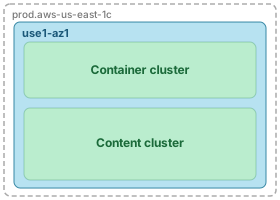
A traditional zone in Vespa Cloud is tied to a single availability zone (AZ). Deploying to such a single-AZ zone results in the application running in that AZ.
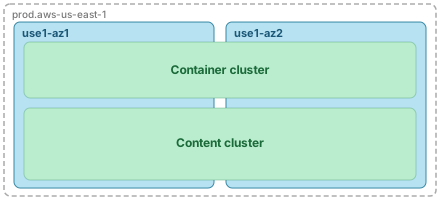
Vespa Cloud also has zones like `prod.aws-us-east-1` that support multiple availability zones, aka _multi-AZ_ zones. To deploy to a multi-AZ zone, you _must_ specify a list of availability zones, using the `` elements in the `` element, see [deployment.xml](../reference/applications/deployment.html#availability-zone).
|
Single-AZ zone
 |
Multi-AZ zone
 |
It is an error to deploy to a multi-AZ zone and not specifying at least one AZ. If you specify exactly one AZ, it is identical to deploying to a traditional zone tied to that AZ.
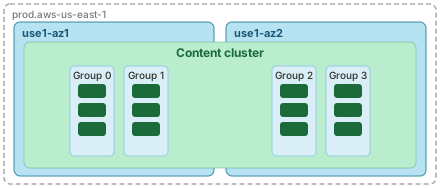
Specifying more than one AZ means your application instance will spread evenly across those AZ. This means the number of nodes in each cluster must be a multiple of the number of AZs. For content clusters, the number of groups must also be a multiple of the number of AZs.
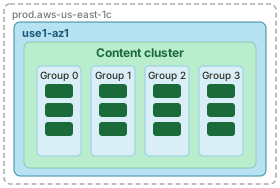
For example, let's say an application instance has been configured in deployment.xml with 2 availability zones `use1-az1` and `use1-az2`, and a content cluster in services.xml specifies 4 groups and a total of 12 nodes. Each group contains 3 nodes. This means 2 groups will be placed in `use1-az1`, and 2 groups will be placed in `use1-az2`.
|
Single-AZ zone
 |
Multi-AZ zone
 |
## Benefits to multi-AZ applications
Deploying a single application instance to multiple availability zones, instead of deploying multiple application instances to each of those availability zones, has several benefits:
1. A single load balancer spanning backends across AZs is more reliable than a DNS-based global endpoint wrapping the zonal endpoints.
2. Document embedding is cheaper, as it needs to be done once instead of once per AZ.
3. Feeding to a single endpoint is simpler and more robust than feeding to one endpoint for each AZ. For instance, if an entire AZ goes down, then feeding to a multi-AZ application instance still works. And once the AZ comes back online, the nodes in that AZ will automatically have their documents updated from the nodes in the other AZs.
4. Deploying two instances of the same application to two AZs in the same region, with `redundancy=1`, is prone to data loss. Instead, one application instance can be deployed to those two AZs.
Copyright © 2026 - [Cookie Preferences](#)